What Is an Invoice? Types, Tax Invoices and Billing Explained
What Is an Invoice? Types, Tax Invoices and Billing Explained
Imagine a customer buying goods from a Kathmandu shop and asking to pay next week. The products have already left the shop, but the money hasn't arrived. How does the shopkeeper keep track of what the customer owes?
That's where an invoice comes in.
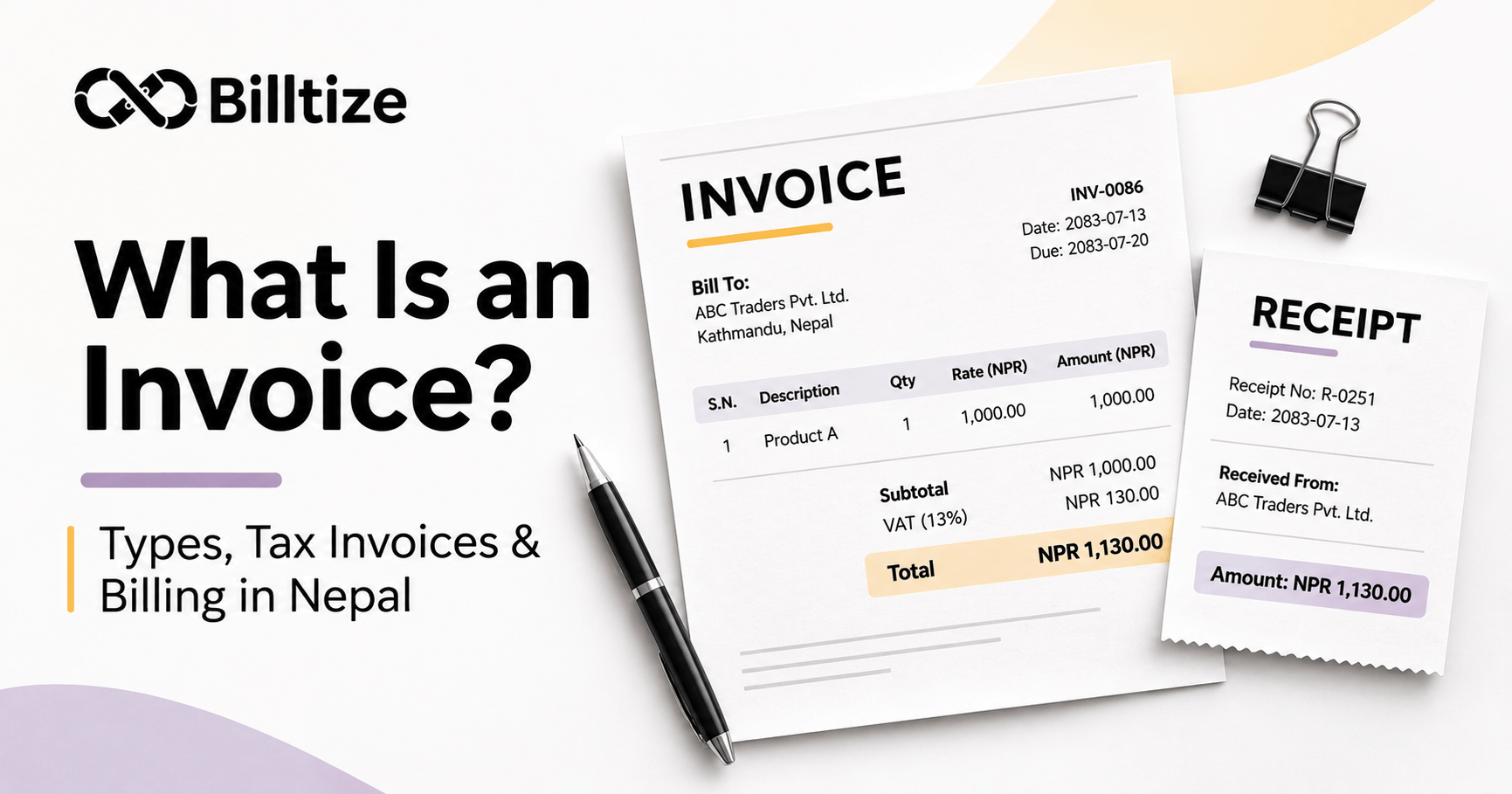
An invoice is a document issued by a seller that records the goods or services supplied, their prices and the amount payable by the customer. It provides a record of the sale, whether payment happens immediately or later.
A receipt serves a different purpose. It confirms that money has been received.
Both documents are part of everyday business accounting in Nepal, especially for shops that handle cash sales, udharo (credit) and partial payments.
What information should an invoice include?
An invoice doesn't need a complicated design. It just needs to make the transaction clear.
Think about a customer returning after two weeks to ask about a purchase. A properly prepared invoice should help both parties find the details without searching through notebooks.
Most invoices include:
-
Seller and customer details: Business name, address, PAN and customer information where applicable.
-
Invoice number and date: So the transaction can be identified later.
-
Items sold: Product or service names, quantities and rates.
-
Amounts: Discounts, applicable taxes and the final bill total.
-
Payment details: Payment terms and any remaining balance.
The exact information required depends on the invoice type and the seller's tax registration. A normal sales bill, for example, isn't automatically a valid VAT tax invoice.
What are the different types of invoices?
You may have seen documents labelled invoice, tax invoice, receipt or credit note. They aren't all meant for the same situation.
| Document | When it's used |
|---|---|
| Sales invoice | Records goods or services sold and the amount charged |
| Pro forma invoice | Shows an estimated price before a transaction is finalized |
| VAT tax invoice | Documents a supply using the prescribed tax-invoice format |
| Receipt | Confirms a payment received from a customer |
| Credit or debit note | Records an adjustment to an earlier invoice, such as a return or price change |
Take a pro forma invoice as an example. A supplier might send one before delivering products so the buyer knows the expected cost. Once the sale takes place, the appropriate final invoice is still needed.
A receipt, meanwhile, shows how much money was collected. It doesn't necessarily mean the entire invoice has been paid.
PAN bill or VAT bill: What's the difference in Nepal?
This is something small business owners should understand before issuing bills.
Having a PAN number doesn't automatically allow a business to charge VAT. A business registered for PAN but not VAT must not simply add 13% VAT to its bills.
For VAT-registered businesses, Rule 17 of Nepal's Value Added Tax Rules, 2053 generally requires a tax invoice in the prescribed format for taxable supplies.
Nepal's standard VAT rate is 13%, but not every product or service has the same VAT treatment. Some supplies may be exempt or zero-rated.
You might also have seen shorter retail tax invoices. Rule 18 provides for abbreviated tax invoices in specified circumstances, subject to permission from the relevant tax officer and other conditions.
You can check the IRD VAT Rules for the official requirements. Businesses considering computerized invoicing can also read about IRD e-billing software in Nepal.
Invoice vs receipt: A Kathmandu shop example
Suppose a VAT-registered shop sells two taxable items worth NPR 1,000 before VAT.
The customer has only NPR 300 available and agrees to pay the rest later.
Assuming the standard 13% VAT rate and no discounts:
| Details | Amount |
|---|---|
| Value of goods | NPR 1,000 |
| VAT (13%) | NPR 130 |
| Total invoice | NPR 1,130 |
| Amount paid | NPR 300 |
| Remaining balance | NPR 830 |

The invoice records the full NPR 1,130 sale. The shop can issue a receipt or record the NPR 300 payment, but the customer still owes NPR 830.
The sale has been recorded. The money, however, hasn't all been collected.
For shops dealing with regular customers and udharo, keeping billing and customer payment records together helps the owner see which invoices are settled and which are still outstanding.
For businesses that handle many counter sales, POS billing and receipt printing can also make day-to-day checkout more manageable.
This is a simplified example of a standard-rated taxable sale, without discounts or additional charges.
What if an invoice has to be corrected?
Returns and billing adjustments are normal parts of running a business.
Maybe a customer returns a damaged product. Or perhaps the seller charged the wrong amount and needs to correct it.
Instead of simply erasing the original transaction, the business may need a credit note or debit note to document the change.
A credit note commonly reduces an amount previously charged by the seller. A debit note can document an increase in the amount billed or a purchase adjustment from the buyer's side, depending on the circumstances.
For VAT-registered transactions, Rule 20 of the Value Added Tax Rules, 2053 covers debit and credit notes when the value of a supply changes. The document needs to refer to the original tax invoice and explain the relevant adjustment in value and VAT.
These changes also matter when preparing sales and purchase records. Our guide to VAT registers and Annex 13 reporting in Nepal explains that reporting process.
How Billtize makes everyday billing easier
Writing a few bills by hand might seem easy enough. But imagine having to remember which customer paid yesterday, which invoice is still pending and whether a returned item has been adjusted properly.
As transactions increase, keeping everything organized becomes more important.
With Billtize, businesses can prepare invoices, select customers, add products and calculate applicable taxes and discounts from one web-based system.

The invoice screen includes Pay Now and Pay Later options. Businesses can also record customer payments, review outstanding balances and manage customer credit notes.
Billtize connects sales billing with inventory management, helping businesses review product and stock information alongside transactions.
The same platform also includes accounting software and financial reports, such as ledgers, Trial Balance, Income Statement and Balance Sheet.
For a shop owner, the benefit is straightforward: billing, customer payments, stock and accounting information can be reviewed in one system instead of being scattered across separate records.
Frequently asked questions
Can I issue an invoice if my business isn't VAT registered?
Yes. Businesses without VAT registration can issue ordinary sales bills or invoices as applicable. However, having a PAN alone doesn't authorize them to charge VAT.
Is a pro forma invoice a final bill?
No. A pro forma invoice usually shows an expected price before a transaction is completed. It doesn't replace the required final invoice for an actual sale.
Does issuing an invoice mean the customer has paid?
Not always. A customer might pay immediately, later or in several installments. The invoice records the amount charged, while payment records show what has actually been collected.