VAT Billing and CBMS in Nepal: Electronic Invoicing and Reporting Explained
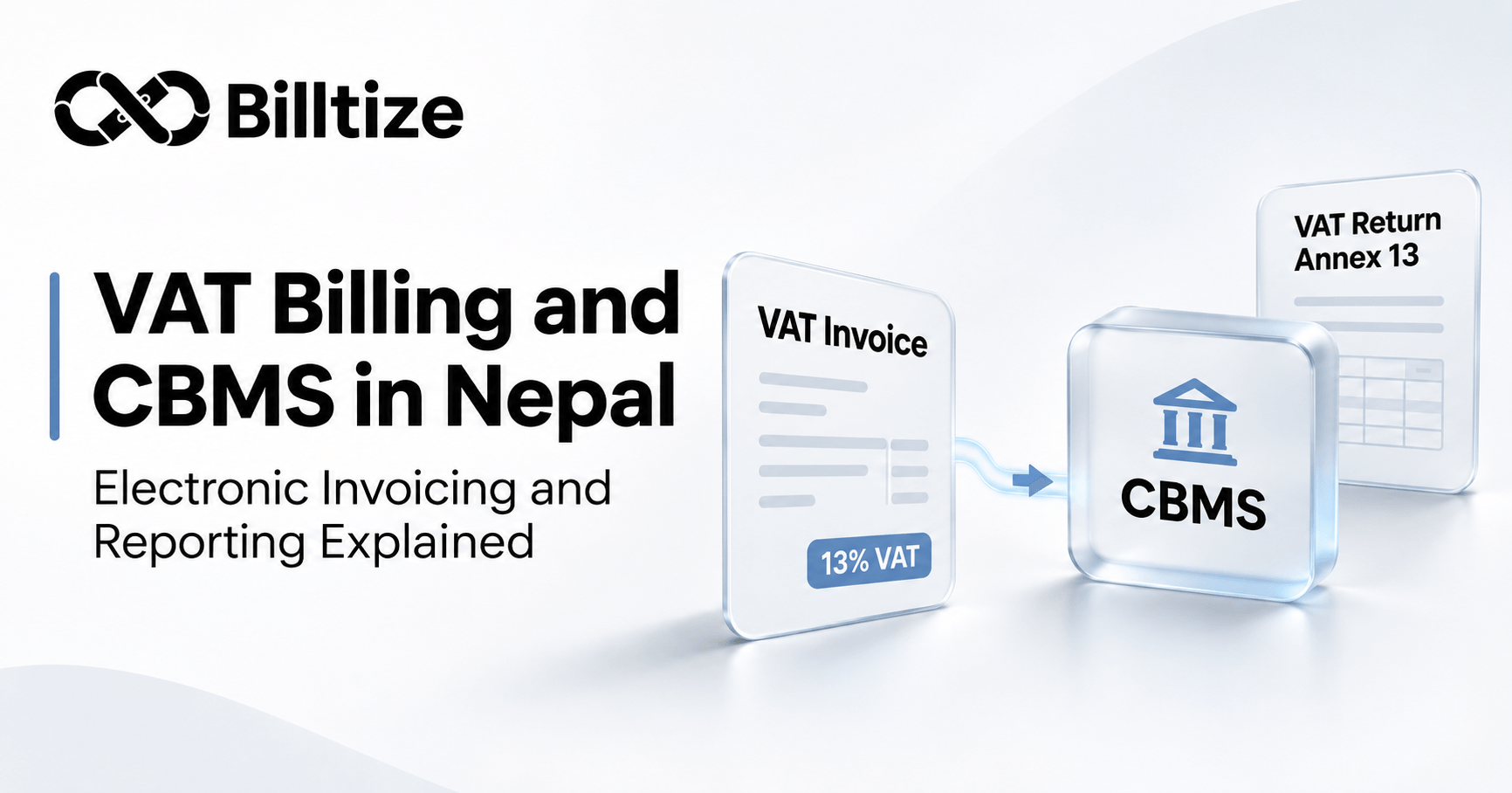
VAT Billing and CBMS in Nepal: Electronic Invoicing and Reporting Explained
A business may finish issuing its VAT bills for the day, yet some of those invoices could still be waiting for confirmation from the Inland Revenue Department (IRD).
For businesses connected to CBMS, an invoice being saved or printed doesn't necessarily mean IRD has received its details.
VAT billing records taxable sales, CBMS monitors electronic invoice information from connected taxpayers, and VAT return filing reports tax for a particular period. These are related activities, but each has a different purpose.
How does VAT billing work in Nepal?
When a VAT-registered business sells taxable goods or services, it generally needs to issue a tax invoice in the prescribed format.
Rule 17 of Nepal's Value Added Tax Rules, 2053 sets out the tax-invoice requirements. The standard VAT rate is 13%, although exempt and zero-rated supplies receive different treatment.
Suppose a Kathmandu business sells taxable goods worth NPR 20,000 before VAT.
| Invoice details | Amount |
|---|---|
| Taxable value | NPR 20,000 |
| VAT (13%) | NPR 2,600 |
| Total invoice | NPR 22,600 |
The customer is charged NPR 22,600, including NPR 2,600 in VAT. Whether the customer pays immediately or later is a separate matter.
This example assumes a standard-rated sale without discounts. A business registered only for PAN cannot charge VAT simply because it issues an invoice.
For everyday invoicing, see our billing software guide for businesses in Nepal.
What happens when an invoice is sent to CBMS?
CBMS stands for Central Billing Monitoring System. It allows IRD to receive and monitor electronic invoice information from taxpayers connected to the system.
For businesses required to use CBMS, the applicable invoice details must be transmitted when the invoice is issued.
A connection problem, incorrect information or technical error can interrupt that transmission. The billing system should therefore allow users to check whether submissions were acknowledged or need attention.
This also helps businesses keep their electronic invoice records consistent with the information received by IRD.
Is CBMS compulsory for every business in Nepal?
No. Not every VAT-registered business is automatically required to connect to CBMS.
Section 14A of the Value Added Tax Act, 2052 provides the legal basis for electronic invoicing requirements and IRD's authority to require specified taxpayers to connect to the monitoring system.
On 4 Baisakh 2083, IRD published a notice requiring taxpayers with annual turnover exceeding NPR 20 crore to issue electronic invoices and connect them to CBMS.
The notice provides exceptions for certain organizations, including banks and financial institutions that do not directly issue customer invoices because of their business activities.
Other IRD notices or taxpayer-specific requirements may also apply, so the turnover notice should not be treated as the only possible basis for a CBMS obligation.
Businesses can review the official IRD CBMS notice to understand the stated requirements.
Is CBMS reporting the same as filing a VAT return?
No. Electronic invoicing, CBMS transmission and VAT return filing serve different purposes.
| Process | Purpose |
|---|---|
| Electronic tax invoice | Records an individual taxable sale |
| CBMS transmission | Sends applicable invoice information to IRD |
| VAT return filing | Reports sales, purchases, adjustments and VAT for the relevant tax period |

Even after all required invoices have reached CBMS, businesses must still prepare and file their applicable VAT returns separately.
Our guide to VAT registers and Annex 13 reporting in Nepal explains how businesses can organize the underlying records.
What should you do if a CBMS invoice fails to sync?
Start by checking whether IRD received the original invoice.
If the submission failed, review the error and follow the correction or retry process supported by the billing system.
Avoid creating a second invoice for the same sale simply because the first one appears unsuccessful. Otherwise, the business could end up with duplicate records.
Checking submission statuses regularly makes it easier to find unresolved invoices before they become a reporting problem.
The Electronic Billing Procedure, 2074 provides the regulatory framework for electronic billing software.
How we manage VAT billing and CBMS in Billtize
At Billtize, we bring invoicing, customer payments, inventory and accounting together in one web-based system.
Our IRD e-billing features support tax calculations, electronic invoice records and CBMS-connected workflows for properly configured businesses.
When IRD synchronization is enabled, approved invoices can be transmitted through the supported workflow. We also provide submission-status tracking so users can identify failed submissions and retry them when necessary.
The Billtize demo invoice screen below shows how customers, products, taxes and payment options are recorded. The figures are demonstration data, not proof of successful transmission to IRD.

Alongside billing, our accounting software for businesses in Nepal helps businesses review the financial records behind those transactions.
Before relying on electronic billing for statutory compliance, businesses should confirm their applicable IRD requirements, software authorization and CBMS configuration.
Frequently asked questions
Can a PAN-registered business charge 13% VAT?
PAN registration alone does not authorize VAT collection. The seller must have the appropriate VAT registration, and the goods or services must be subject to VAT.
What is the current turnover threshold for mandatory CBMS connection in Nepal?
The IRD notice dated 4 Baisakh 2083 specifies annual turnover exceeding NPR 20 crore, subject to its stated exceptions. Other applicable notices and taxpayer-specific requirements should also be checked.
Can I edit or delete an invoice after it has been sent to CBMS?
An issued invoice should not simply be deleted or overwritten to change the transaction history. When the value of a taxable supply legitimately changes, Rule 20 of the Value Added Tax Rules, 2053 provides for credit or debit notes linked to the original invoice.
In Billtize, approved invoices cannot be edited once IRD synchronization is enabled, and sales invoices cannot be deleted. Supported sales-credit workflows are used for applicable corrections. Other errors should be handled according to the relevant IRD procedure.