Understanding Financial Statements: Profit and Loss, Balance Sheet and Cash Flow
Understanding Financial Statements: Profit and Loss, Balance Sheet and Cash Flow
A busy shop isn't always a profitable one. And even when sales look good, a shopkeeper may still be waiting for customers to pay. The day's sales figure doesn't tell the whole story.
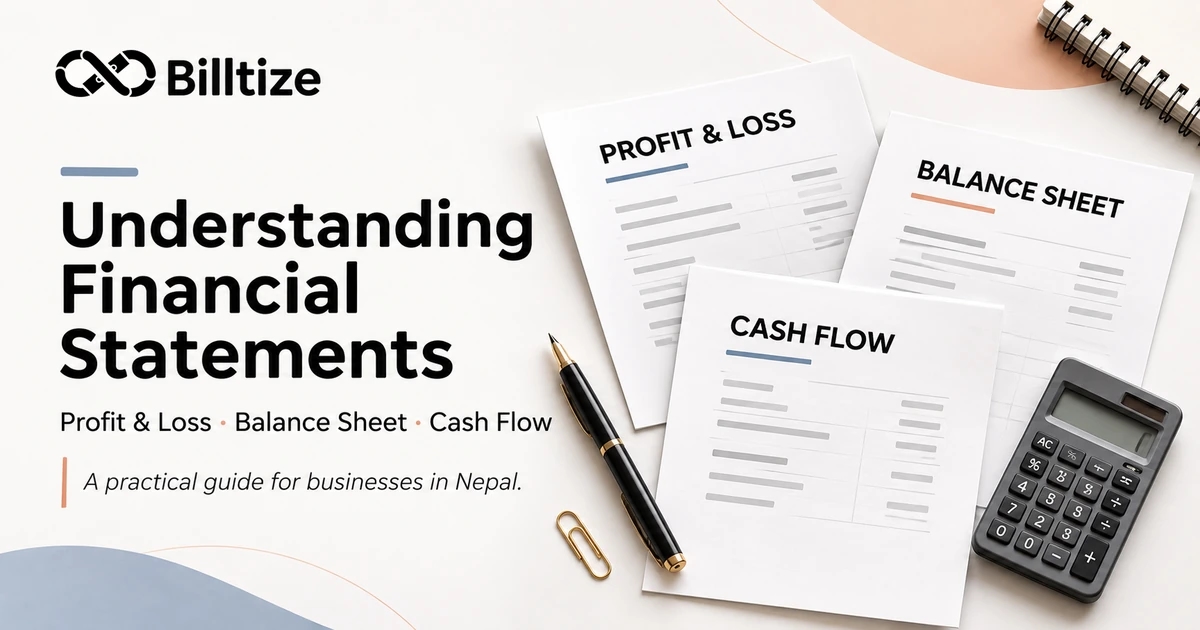
Financial statements help answer three questions: Did the business make a profit? What does it own and owe? And where did its cash go? The Profit and Loss Statement, Balance Sheet and Cash Flow Statement each answer a different part of that question.
If you're new to these terms, start with our guide to what accounting means for businesses in Nepal.
Profit and Loss Statement: Did the business make money?
Suppose a shop sells NPR 100,000 worth of goods in a month. That's encouraging, but it isn't NPR 100,000 in profit. The goods had a cost, and the shop still had rent, wages and electricity to pay.
A Profit and Loss (P&L) Statement, also called an Income Statement, brings income and expenses together for a particular period. For a simple retail business, without other income or costs:
Profit before tax = Sales revenue − Cost of goods sold − Other expenses.
The cost of goods sold is the cost of stock actually sold, not everything bought during that month. Good inventory and stock records make that distinction easier to track.
A P&L may cover a month, quarter or Nepal's fiscal year, from Shrawan to Ashadh. It's different from VAT recordkeeping; our VAT registers and Annex 13 guide explains that separate requirement.
Balance Sheet: What does the business own and owe?
The P&L looks at performance over time. A Balance Sheet shows the business's financial position on a specific date—what it owns, what it owes and what's left for the owner.
| Component | What it includes |
|---|---|
| Assets | Cash, stock, equipment and customer receivables |
| Liabilities | Supplier dues, loans and other obligations |
| Owner's equity | The owner's remaining interest after liabilities |
The figures follow the accounting equation: Assets = Liabilities + Equity. If a business has NPR 200,000 in assets and owes NPR 80,000, the remaining equity is NPR 120,000.
Cash Flow Statement: Where did the cash go?
This is where udharo—sales on credit—becomes important. A shop can record a sale today and receive the money weeks later. Meanwhile, its supplier may expect payment tomorrow.
A Cash Flow Statement shows cash received and paid during a period, divided into three activities: operating (day-to-day collections and payments), investing (such as buying equipment) and financing (such as borrowing money or repaying loan principal).
Keeping billing and customer payment records up to date helps an owner separate money earned from money actually collected.
P&L vs Balance Sheet vs Cash Flow: What's the difference?
P&L measures profit, the Balance Sheet shows financial position, and Cash Flow explains cash movement. Here's the distinction at a glance:
| Statement | Timeframe | Main question |
|---|---|---|
| Profit and Loss | Over a period | Did the business make a profit or loss? |
| Balance Sheet | On a specific date | What does the business own and owe? |
| Cash Flow Statement | Over a period | Where did cash come from and go? |
A Kathmandu shop example: One month, three answers
Imagine a small shop begins the month with NPR 50,000 in cash, invested by its owner. During the month, it buys NPR 65,000 in stock for cash, sells goods for NPR 100,000 (the goods sold cost NPR 60,000), collects NPR 70,000 from customers and pays NPR 20,000 in other operating expenses.
| Report | Calculation | Result |
|---|---|---|
| Profit and Loss | 100,000 − 60,000 − 20,000 | NPR 20,000 profit |
| Cash movement | 70,000 − 65,000 − 20,000 | NPR 15,000 decrease |
| Balance Sheet | Cash 35,000 + Receivables 30,000 + Stock 5,000 | NPR 70,000 assets |

Closing cash is NPR 35,000: the opening NPR 50,000 less the NPR 15,000 decrease. Closing equity is NPR 70,000: the original NPR 50,000 plus NPR 20,000 profit. The example has no liabilities.
So the shop earned a profit, but finished with less cash. NPR 30,000 is still due from customers, and NPR 5,000 remains in stock. You need all three views to see why.
This is a simplified example without taxes, owner withdrawals or unrelated transactions.
How does Billtize help businesses review their accounts?
At Billtize, we bring billing, inventory and accounting together in one cloud-based system. Our accounting software for businesses in Nepal includes Income Statement, Balance Sheet and Trial Balance reports, with Bikram Sambat (BS) dates and Nepali fiscal-year support.
In the Billtize Income Statement shown below, Direct Income, Cost of Sales, Gross Profit/(Loss), Indirect Income and Indirect Expenses have their own sections.

The reports are based on accounting records. Double-entry accounting helps keep debits and credits in balance, while cash and bank receipts and payments help owners understand cash movement. These records answer different questions, so they are most useful when reviewed together.
Frequently asked questions
Can a business make a profit and still have less cash?
Yes. A shop might sell on credit while paying suppliers and expenses before customers settle their bills.
Is the Balance Sheet more important than the P&L?
Neither replaces the other. The P&L shows performance over a period; the Balance Sheet shows the business's financial position on a particular date.
Where does the Trial Balance fit in?
A Trial Balance gathers ledger balances and checks whether total debits equal total credits. It helps prepare financial statements, although matching totals don't guarantee that every entry is correct.