How Double-Entry Accounting Works: Debit, Credit, Journal Entries and Ledgers
How Double-Entry Accounting Works: Debit, Credit, Journal Entries and Ledgers
Double-entry accounting records every transaction with equal total debit and credit amounts across at least two accounts. It helps businesses in Nepal track what they own, owe, earn and spend while keeping financial records consistent.
New to accounting? Start with our beginner's guide, What Is Accounting? Meaning, Process and Importance for Businesses in Nepal, to understand the basics before learning double-entry bookkeeping.
What do debit and credit mean in accounting?
Debit (Dr) is the left side of an account; credit (Cr) is the right side. Neither always means money received or paid. Their effect depends on the account type.
| Account type | Increases with | Decreases with |
|---|---|---|
| Assets and expenses | Debit | Credit |
| Liabilities, equity and income | Credit | Debit |
For example, stock purchased on credit increases inventory (an asset) and the amount owed to a supplier (a liability).
How does double-entry accounting work? A Nepal example
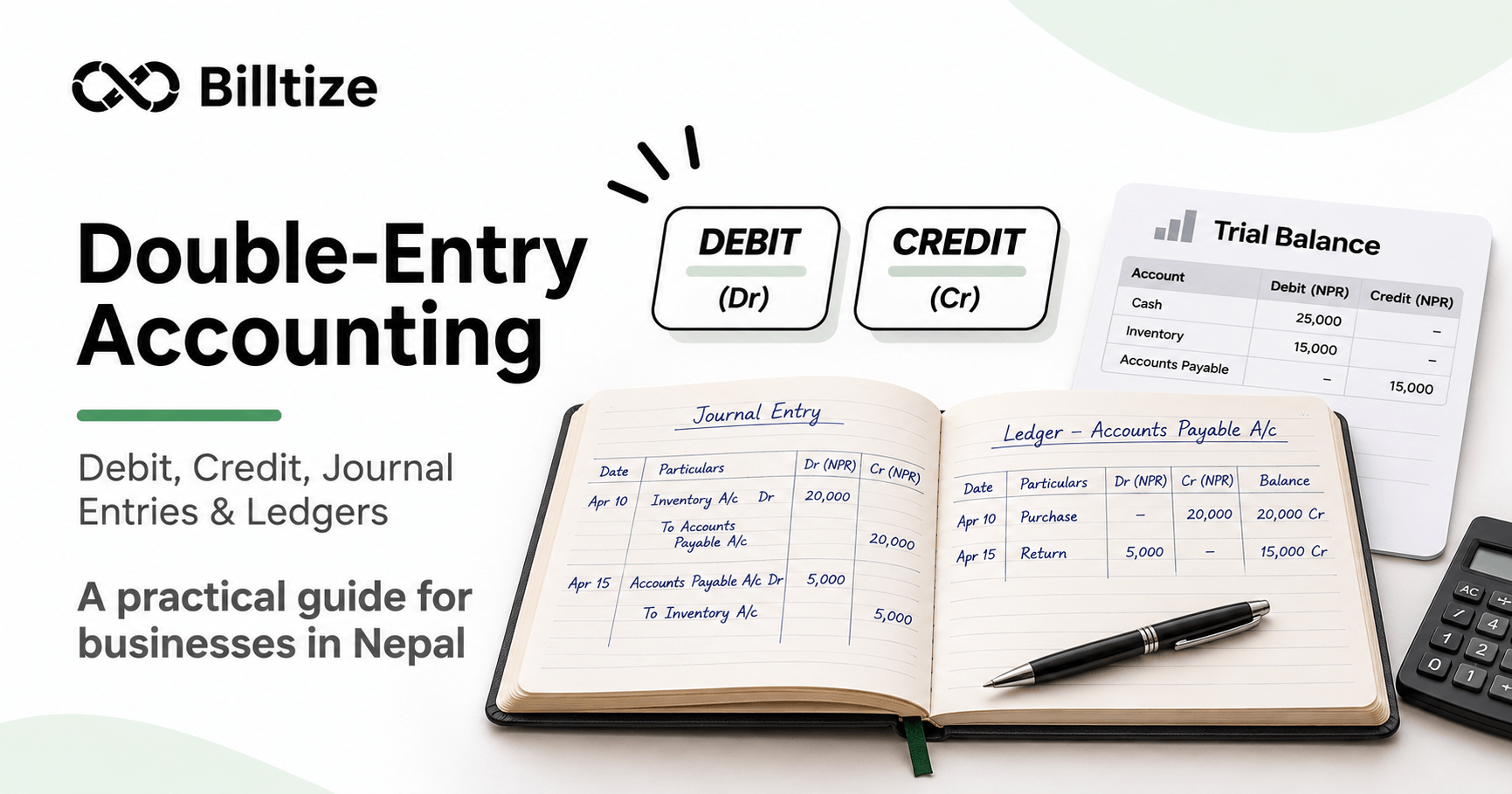
Imagine a Kathmandu retailer buys NPR 20,000 of stock on credit. Under a perpetual inventory system, the journal entry is:
| Account | Debit (NPR) | Credit (NPR) |
|---|---|---|
| Inventory | 20,000 | — |
| Accounts Payable | — | 20,000 |
| Total | 20,000 | 20,000 |
The retailer now owns more stock but owes the supplier NPR 20,000. No cash has been paid yet.
If the retailer returns NPR 5,000 of that stock, the reversing entry is debit Accounts Payable NPR 5,000 and credit Inventory NPR 5,000. The remaining supplier balance is NPR 15,000.

Accurate inventory and stock records help businesses track the goods behind these financial entries.
Illustrative example; excludes VAT, discounts and other transactions.
What is the difference between a journal entry and a ledger?
A journal records transactions in chronological order; a ledger groups them by account. In the example above, the Inventory and Accounts Payable entries appear in the journal and are posted to their respective ledgers.
The Accounts Payable ledger shows NPR 20,000 credited and NPR 5,000 debited, leaving NPR 15,000 payable.
A Trial Balance summarizes ledger account balances to check whether total debits equal total credits, although it cannot detect every accounting error.
What are debit notes and credit notes in Nepal?
Debit notes and credit notes document adjustments to an earlier invoice. They are different from debit and credit journal entries.
| Document | Example when goods are returned |
|---|---|
| Debit note | The buyer documents the return and reduction in the amount payable. |
| Credit note | The seller acknowledges the return and reduces the customer's amount due. |
For the NPR 5,000 purchase return, the buyer may issue a debit note and the seller a corresponding credit note. A debit note can also document an increase in the amount invoiced, depending on which party issues it and why.
For VAT-registered supplies, Rule 20 of Nepal's Value Added Tax Rules, 2053 covers credit and debit notes when a supply's value changes. Required details include the original tax invoice number and date, reason for adjustment, adjusted amount, related VAT amount and identification details. Registered taxpayers must maintain monthly records of these notes.
For the legal requirements, see the IRD Value Added Tax Rules. For practical invoicing and adjustment features, explore Billtize's billing software in Nepal.
How does Billtize support double-entry accounting?
At Billtize, we bring journal vouchers, a chart of accounts, ledgers and financial reports together in one cloud-based system. Our accounting software for businesses in Nepal includes Trial Balance, Income Statement and Balance Sheet reports, along with Bikram Sambat (BS) dates and Nepali fiscal-year support.
The demo Trial Balance displays account groups with debit and credit balance columns, showing how accounting information can be reviewed in an organized format. The screenshot uses demo data, separate from the NPR 20,000 example above.

Billtize also supports customer credit notes and supplier debit notes for managing transaction adjustments.
Frequently asked questions
Must every journal entry have exactly two accounts?
No. A journal entry can involve three or more accounts, provided the total debit equals the total credit.
Does a debit always increase an account?
No. A debit increases an asset or expense account but decreases a liability, equity or income account.
Is a debit note the same as a debit entry?
No. A debit entry is posted to the left side of an account. A debit note is a business document recording an adjustment to an invoice or transaction.