How GPS Staff Attendance & Nepali Month (BS) and English Month (AD) Payroll Save Hours for Business Owners in Nepal
Payroll Day in Nepal: Why It Still Eats Two Days
The 30th. Salaries go out tomorrow. The Kathmandu shop manager is still sending attendance photos on Viber, your accountant is counting unpaid leave on a calculator, and the advances from Dashain are in a notebook that hasn’t been opened since Bhadra.
Sound familiar? It should. Most Nepali businesses run payroll this way, and the people doing it aren’t careless. They’re just stitching together four tools that were never meant to talk to each other.
Where it falls apart
Start with attendance. A paper register is an honor system, and a friend can sign for you. A thumbprint scanner is better until the power goes, and then somebody exports the data to a USB stick and carries it to the accountant. Neither tells you anything about the delivery driver or the sales rep who spends his week between Pokhara and Butwal.
Then the calendar. Local shops and traders pay by Bikram Sambat month, and those months run 29 to 32 days. Agencies and INGOs usually pay by AD month but still have to report salary TDS on the Nepali fiscal year. So somebody is always converting dates, and one wrong day changes what an unpaid-leave deduction should be. Imported software doesn’t rescue you. TallyPrime and QuickBooks assume Indian or Western tax rules, which means the BS working days and the tax brackets end up back in Excel. After all that, the accountant types every salary voucher into the books a second time. Same numbers entered twice.
What we built instead
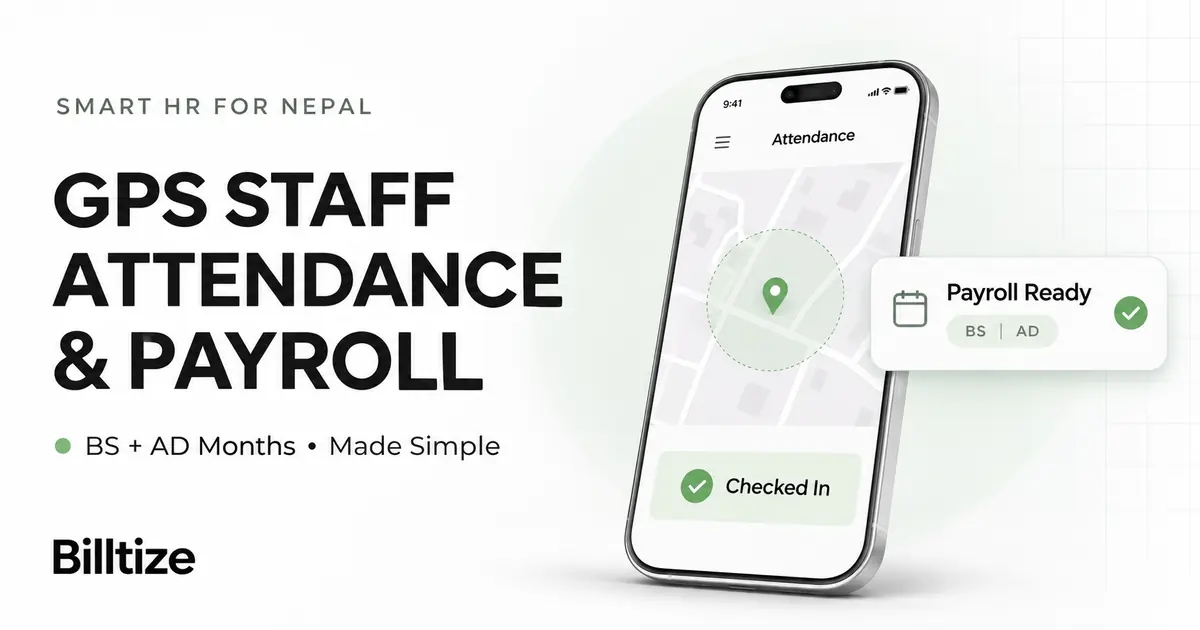
Billtize keeps attendance, payroll and the ledger in one place, so nothing gets typed twice. Staff clock in from their own phones. You draw a GPS zone around each store, warehouse or branch, and the app only accepts a check-in from inside it. Field reps and drivers can get remote check-in if you switch it on, and it records where they were and when. From your phone or laptop you can see who’s in, who’s late, who’s on leave and who simply didn’t show, across every branch. Hours, late arrivals, early exits and overtime are calculated for you. You can hand out tasks with deadlines from the same screen too.
Payroll reads that attendance directly. Pick Nepali months (Shrawan to Ashad) if you’re a retailer, wholesaler or manufacturer. The system copes with the 29-to-32-day months, so the daily deduction comes out right, and it lines up with the fiscal year that starts on Shrawan 1. Pick English months if you’re an IT firm, agency, hotel or BPO that pays on the 1st or the last day of the AD month. Payslips stay in AD, and the ledgers still follow the Nepali fiscal year.
When you run payroll, approved attendance and leave come in automatically. Basic salary, dearness allowance, travel or fuel allowance and the Dashain bonus are set up once. Advances (peshki) come off the pay on their own, because they live in the same system. SSF, EPF and CIT deductions apply, along with the progressive slabs, the single and married rates and the rebates under the Income Tax Act, 2058. Approve it and the journal posts itself, with Salary and Wages Expense on the debit side and Salary Payable, Salary TDS Payable and the other deductions on the credit side.
The time it gives back
For a retail and distribution business with about 25 staff, our estimate is roughly 15 hours a month. Collecting and checking attendance takes about 4 hours today and almost none after. Date conversion and leave counting go from 3 hours to 5 minutes. Slabs, TDS and SSF/CIT go from 4 hours to about 10 minutes. The advance checks and voucher posting, around 2 hours each, simply disappear.
The money side is simpler. Scanners can cost NPR 15,000 to 40,000 or more per branch. Phone-based attendance costs nothing extra, and there are no per-user HR fees.
Quick answers
Can someone clock in from home?
Not unless you’ve allowed it for that person. The GPS check is the whole point.
BS and AD?
Both, across attendance, payroll, billing and reports.
Is HR a paid add-on?
No. It’s part of the plan.
How is this different from TallyPrime?
Tally’s payroll follows Indian rules and has no phone GPS attendance, leave workflow or task tracking.
One Place for People, Payroll and Books
Attendance in one app, salary TDS in a spreadsheet, VAT and accounts in a third program. That’s a lot of tabs for a job that should be routine.
In Billtize, staff check in by GPS, payroll runs in BS or AD, and your ledgers and IRD reports stay current from wherever you happen to be. Same numbers, entered once